
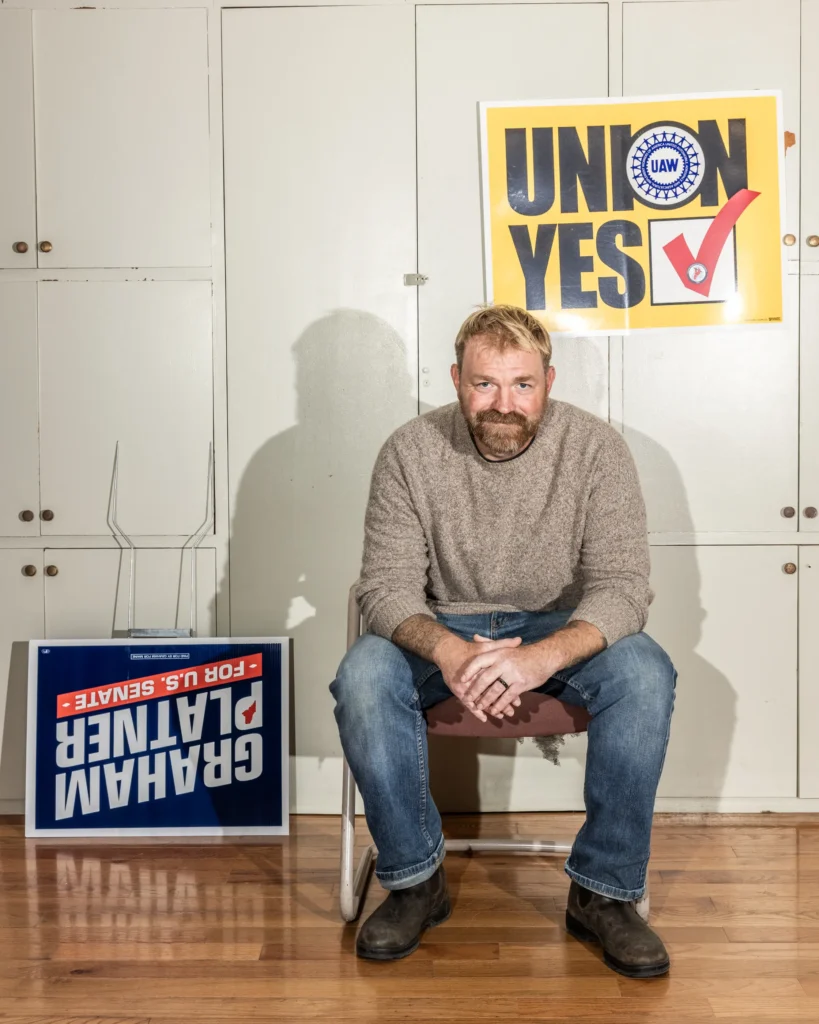
SURJ proudly endorses Graham Platner for Maine Senate in the June 9 Democratic primary. Across the country, SURJ members and local chapters are knocking doors, making calls, and organizing for bold candidates who will stand up to the Trump agenda.
Slowing MAGA authoritarian consolidation is our primary task this year. We are doing that in two ways: through mass action and through elections. Both are necessary. We must continue building protests in the streets and community defense that challenge Trump’s agenda–while also contesting the institutions of power that enable it.
Our movement partners want and need us to take up electoral work to break the Republican trifecta at the federal level, especially in places that are overwhelmingly white. Maine fits that bill. That is why this year SURJ is supporting working-class champions in congressional races across the country, from coast to coast.
For SURJ, electoral work is not simply about casting a vote. It is about electing candidates who are part of our movement against ICE, against the genocide in Palestine, and against right-wing authoritarianism. We want candidates who will lead on the issues our movements care about.
Graham embodies the kind of change we believe is needed among millions of white people in this country: a shift away from militarism and racism and toward multiracial working-class solidarity that explicitly rejects racism.
Why Does SURJ Back Graham?
To win the Senate back from the authoritarian GOP, we believe we need Democrats who are fighters, rooted in the working class, and willing to reject racist divide-and-conquer politics. Too often, racial justice issues are sidelined or avoided altogether.
SURJ looks for strong candidates not because we think politicians will save us, but because they can help create better conditions for our movements to win. With Graham in the Senate, we would have someone raising issues we care about, such as ICE’s brutality, saying no to war, and opposing the genocide in Gaza.
Graham stands out as exactly the kind of working-class leader who rejects divide-and-conquer politics. This is the kind of leadership our moment calls for. His politics are rooted in solidarity rather than scapegoating.
As a working-class oyster farmer, Graham represents a politics grounded in lived experience rather than elite career paths. When he talks about affordability and economic struggle, it comes from direct experience and authenticity.
Graham has also been willing to defend those that the GOP scapegoats and many Democrats fail to defend. He has unapologetically defended trans people and immigrants and spoken out against the genocide in Palestine. These are issues that Janet Mills does not even mention in her campaign platform.
SURJ believes we must win white working-class people away from the false promises of racism and right-wing populism. Graham is a combat veteran who rejects war based on his firsthand experience in the decades-long wars in Iraq and Afghanistan.
As white anti-racists, our job is not simply to say the right things. Our responsibility is to organize other white people into the multiracial coalition necessary to win real change. We believe Graham has the strongest chance of doing that.
Is He With Us Against ICE?
Graham has been explicit in naming ICE as a central pillar of Trump’s authoritarian project. He treats the defense of immigrant communities as inseparable from the defense of democracy itself.
He has hosted Know Your Rights events and created anti-ICE activism videos that clearly mark him as part of the broader movement challenging authoritarianism. His campaign aligns directly with the organizing work many of us are already doing.
Our work as white people is not to distance ourselves from other white people or perform being the “perfect white people.” Our responsibility is to organize other white people into solidarity and collective action.
Is He Electable?
Because of his strong message, Graham has surged in the polls. In this week’s polling, he has come from almost nowhere to a double-digit lead.
Polling also suggests Graham is favored to defeat the Republican incumbent by larger margins than Janet Mills, his establishment Democratic primary opponent, who is nearly tied with Collins in surveys.
We need bold candidates who can beat MAGA this year. We are already seeing evidence that this approach works with SURJ-endorsed candidates such as Zohran Mamdani and Analilia Mejia, both of whom scored historic upset victories.
What is the Opposition Saying About Him?
Last fall, opponents and Super PACs launched a targeted communications campaign designed to mislead voters about Graham’s politics. The attacks focused heavily on a skull tattoo he received during military service in 2007 and a series of Reddit posts he made shortly after leaving the military.
Graham has since covered the tattoo and publicly stated that he regrets some of the things he said during the most difficult periods of his life. He has spoken openly about how the experience of combat and witnessing the grim realities of war pushed him to rethink his politics and commit to fighting for a better world.
In a November talk in Maine, he addressed the issue directly: “After my combat deployments, I became deeply disillusioned with American foreign policy, with the wars I had taken part in. I was suffering from PTSD. I was not getting any help because I came out of the service at a time when you just didn’t talk about it, and you white-knuckled it through life. Doesn’t work, it turns out.”
He describes this as part of a difficult personal journey. As he has said, it is “a life that I have lived, a journey that has been difficult, that has been full of struggle, that has also gotten me to where I am today.” As Anne Braden reminds us, “change doesn’t come from guilt; it comes from imagining a better world.”

SURJ believes strongly that people can and do change when they confront their past, reflect on their experiences, and commit to something better. That belief is at the core of our organizing in white communities.
For that reason, we do not see Graham as another Jon Fetterman-style opportunist adopting a working-class aesthetic while maintaining conservative positions on immigration, Palestine, or other issues.
Graham’s positions against ICE, against militarism, and against Israel’s genocide in Gaza are clear and consistent with SURJ’s values.
In his own words about Gaza: “I have not minced words on this issue. We are sending American taxpayer dollars to underwrite the starvation of Gaza, in what can only be accurately described as a genocide.”
Why Not Janet Mills?
Maine Governor Janet Mills has been weak on racial justice issues, particularly when it comes to tribal sovereignty in the state. Six years ago, SURJ Maine leaders joined tribal elders in signing a letter criticizing Mills’ approach to sovereignty. Since then, her record has only worsened.
Just last year, Mills vetoed bipartisan legislation that would have prevented the state from seizing tribal land for public use. Graham has taken the opposite stance. As he has said, “The Wabanaki of Maine are entitled to true sovereignty and self-determination. Too often, the state and federal governments have run roughshod over tribal sovereignty.”
Mills has also been slow and inconsistent in responding to ICE raids in Maine. She declined to sign a bill that would have placed barriers on ICE activity, delaying enforcement for months while mass raids were already underway.
At the same time, Graham was actively organizing against ICE mobilizations and supporting community resistance efforts.
Why This Year?
This year’s elections represent a decisive phase in the struggle against authoritarianism. Since Trump returned to office, immigrants and working families alike have faced a massive onslaught.
Hundreds of thousands have been arrested or detained, and dozens have been killed. Estimates suggest roughly 350,000 arrests, 300–400,000 detentions, and more than 32 deaths connected to the enforcement surge.
At the same time, MAGA politics is increasingly unpopular. Approximately 15 million people have participated in protests, and recent polling shows a supermajority of voters disapproving of ICE’s actions. Republicans now face 18 House races rated as toss-ups. As more districts move against them, they must win roughly three-quarters of those races to maintain their slim majority.
Photography by Greta Rybus.
Paid for by SURJ PAC.